
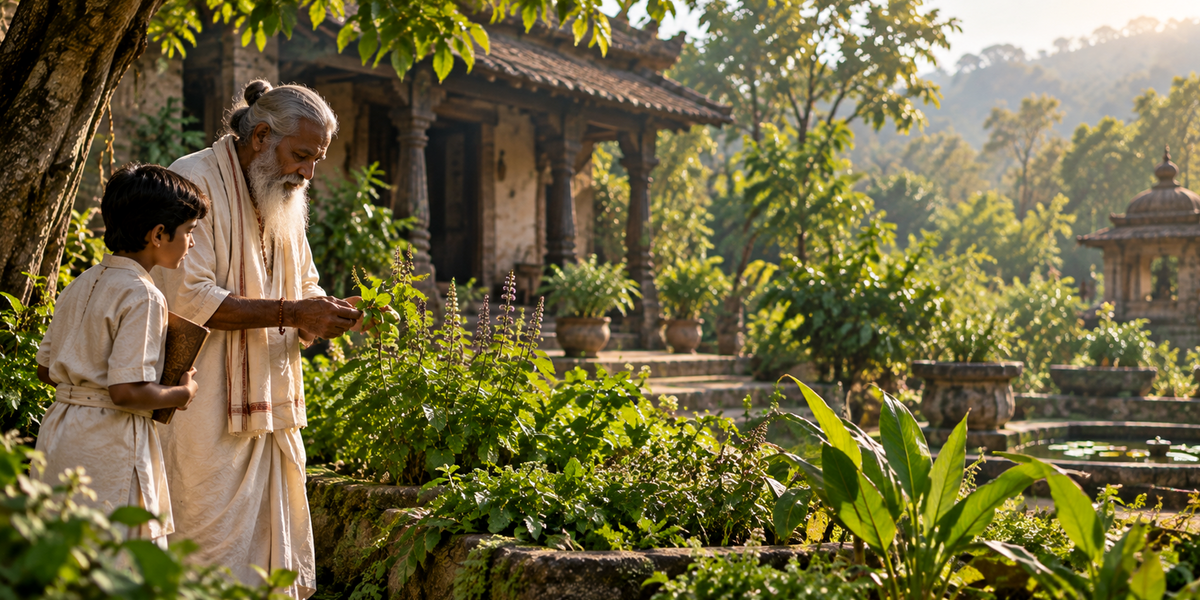
Nature, understood through generations
At the heart of Ayurveda is a deep understanding of nature and its relationship with human wellbeing.
Plants were not simply seen as ingredients. Ayurveda developed a detailed way of understanding them: their qualities, tastes, properties, potency, preparation and the ways in which they could be used.
This knowledge was recorded, refined and passed down through generations in some of India's oldest medical texts.
The Charaka Samhita, one of Ayurveda's foundational texts, is primarily concerned with medicine and describes hundreds of medicinal substances. The Sushruta Samhita, best known for its work on surgery, also records an extensive knowledge of plants and preparations. Later works such as the Ashtanga Hridaya brought together Ayurvedic knowledge in a more concise and accessible form. The Bhavaprakasha Nighantu, a later Ayurvedic materia medica, goes even further into the world of herbs, describing their properties and traditional applications.
Together, these texts reveal something remarkable: India had developed a sophisticated botanical vocabulary long before the modern language of herbal wellness emerged.
Consider some of the plants that have remained part of Indian life for generations.
Tulsi, grown in countless Indian homes, has traditionally been valued for its place in daily health and ritual.
Turmeric, familiar from almost every Indian kitchen, has been used traditionally in food, personal care and wellness practices.
Amla, neem, ginger, ashwagandha and brahmi have each found their own place in India's long tradition of herbal knowledge.
What makes this tradition particularly fascinating is that the knowledge of plants did not remain confined to physicians or ancient texts. It travelled into everyday life.
A grandmother preparing a simple herbal drink.
Tulsi growing beside the entrance of a home.
Turmeric being added to food.
Oil infused with herbs and used in a traditional massage.
The kitchen, the courtyard and the Ayurvedic text were all part of the same living knowledge system.
Ayurveda's botanical tradition is vast. The Ayurvedic Pharmacopoeia of India, for example, documents hundreds of single botanical drugs, reflecting the extraordinary breadth of plant knowledge that has been carried forward within the tradition.
And this knowledge continues to be explored today.
India's Ayurvedic institutions are documenting classical texts, studying medicinal plants and researching traditional formulations, creating a bridge between a knowledge system inherited from the past and the questions of the present.
Perhaps that is the most beautiful way to understand Ayurveda's relationship with herbs:
It is not simply the use of plants. It is a way of understanding nature.
A way of observing what grows around us.
A way of learning from it.
A way of turning that knowledge into everyday practices of care.
For thousands of years, India has carried this conversation between nature, knowledge and wellbeing.
Today, that conversation is finding a new audience around the world.
